
What caused the riots?
When things happen, like the recent riots in the UK, people often attribute a single cause to them, though not necessarily the same cause.

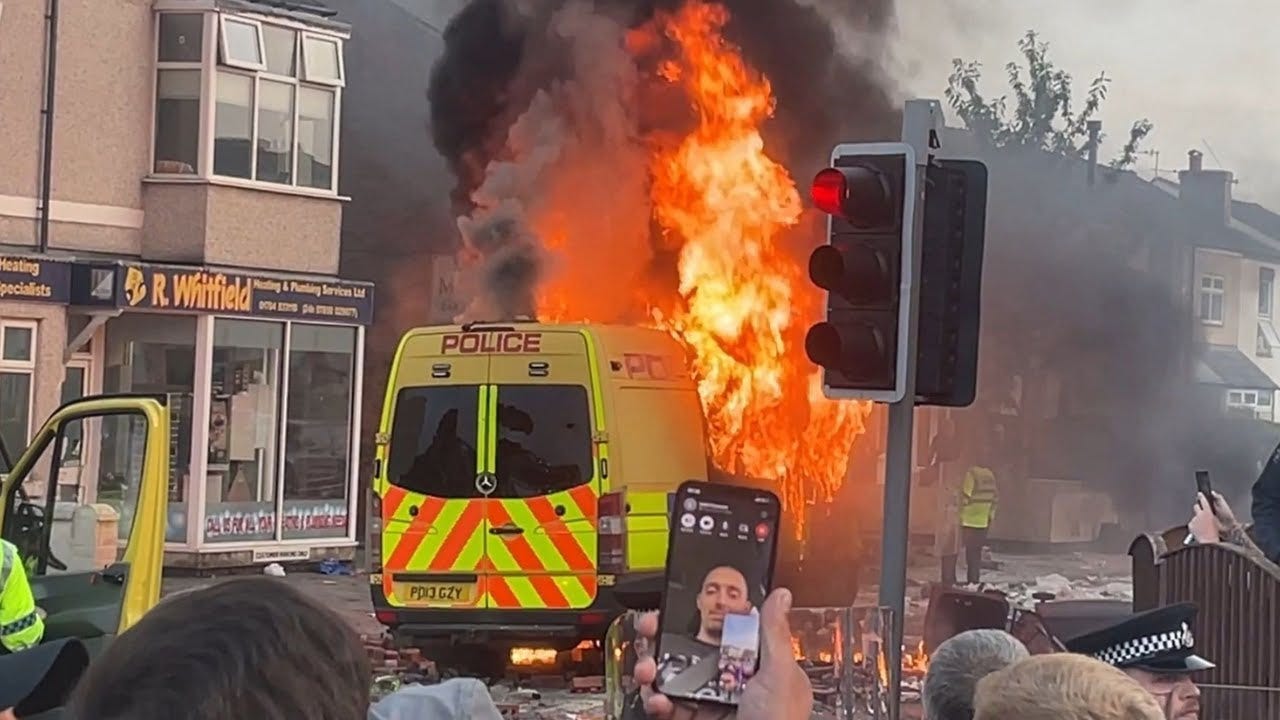
Most things don’t just have a single cause, they have many causes. We tend to pick the cause that best suits our purposes and then ignore or dismiss the rest. If you sympathise with the rioters and think they have a legitimate grievance, you’ll argue that the cause of the riots was that grievance, or was whoever created the conditions for that grievance.
NO. Nigel Farage didn't cause the RIOTS. The ELITE CLASS did.
Matt Goodwin says “Ever since riots and protests erupted on England’s streets, much of the elite class has blamed just one man —Nigel Farage.”
He suggests there that “much of the elite class” is attributing a single cause to the riots and protests, but then he is pinning the blame on his own single cause, the elite class, which in his view does not include Nigel Farage.
If you think the Black Lives Matter protesters had a point, you’ll say the cause of those protests or riots in 2020 was that grievance, the murder of George Floyd and the murders by the police of other unarmed black people.
If you support the Extinction Rebellion and Just Stop Oil protesters you’ll argue that the cause of their protests was the lack of effective government action to tackle carbon emissions, but if you don’t think their protests were a reasonable response to government policy, if you think their beliefs are mistaken, you’d be looking for the cause of those mistaken beliefs.
You may also lump those protesters together, characterise them as one big deluded blob. They’re all far right bigots, spoilt young econuts who ought to get jobs or whatever. But if you agree with their cause, then you may see them in a more nuanced way:
They have a valid point, but I don’t go along with the methods of the more extreme elements.
There are always going to be government policies that much of the public disagrees with, and some that a majority disagree with, but that’s not going to be enough on its own to bring people out onto the streets. According to the BBC:
Almost immediately after the attack, social media posts falsely speculated that the suspect was an asylum seeker who arrived in the UK on a boat in 2023, with an incorrect name being widely circulated. There were also unfounded rumours that he was Muslim.
They also point to social media as an explanation for how the violence spread.
There had been discussion of the rally on regional anti-immigration channels on the Telegram messaging app. Police said the violence was believed to have involved supporters of the now disbanded far-right group the English Defence League (EDL).
They continue:
While there was no single organising force at work, BBC analysis of activity on mainstream social media and in smaller public groups shows a clear pattern of influencers driving a message for people to gather for protests.
Whilst social media certainly makes this kind of communication faster and easier, suggesting it’s more of a catalyst than a root cause. Before social media, such protests would likely have required public meetings and posters. The protests and violence could still have happened, they just would have taken longer to come about. That time between incident and protest may have allowed for more consideration of the facts, whereas now, emotion replaces consideration. Can social media be seen as a root cause then? Does it make people more likely to have a knee-jerk emotive response?
Ed West suspects there’s a more mundane explanation:
As with many of these convictions, one wonders if the real root cause of these disturbances is not really immigration concerns or online misinformation but alcoholism.
Or it could have been a kind of temporary mass psychosis. People so enraged by the murders of the three girls in Southport that they lost their senses. Helen Pluckrose says:
The murder or sexual abuse of children is the thing most likely to provoke a strong visceral reaction in our species. Such crimes can cause the most moderate and peaceable among us to wish we had a death penalty and preferably a painful one, even if fleetingly.
The husband of the woman convicted of posting on Facebook for mosques to be blown up said:
It upset her, it wound her up. She just literally had an emotional breakdown.
It’s not so easy to believe that Nigel Farage had an emotional breakdown when he posted on Twitter that sources said the attacker was an immigrant who had crossed the channel in a boat. He told LBC:
There were stories online from some very prominent folks with big followings, Andrew Tate, etcetera, suggesting the man had crossed the English Channel in October 2023. Other suggestions he was an active Muslim.
Andrew Tate posted on Twitter a few hours after the attack:
An illegal migrant arrived on a boat one month ago.
Then he decided to stab children.
Such misinformation would not have spread so widely or so quickly were it not for social media platforms such as Twitter/X and Facebook, nor if those platforms took down such misinformation more promptly. But how feasible is that? According to the EFF
content moderation does not work at scale, and there is no perfect way to remove false or misleading information from a social media site. But platforms like X have backslid over the past year on a number of measures. Once a relative leader in transparency and content moderation, X has been criticized for failing to remove hate speech and has disabled features that allow users to report certain types of misinformation.
Journalist Carole Cadwalladr points her finger very squarely at Twitter’s owner:
The billionaire owner of a tech platform publicly confronting an elected leader and using his platform to undermine his authority and incite violence. Britain’s 2024 summer riots were Elon Musk’s trial balloon.
Dan Williams however doubts that misinformation can be blamed:
When misinformation is blamed for people’s actions, it is typically because the actions would have been justified if the information had been true. For example, if the Democrats had stolen the 2020 US presidential election, the behaviour of January 6 rioters would have been reasonable, even heroic. Similarly, if vaccines did cause autism, it would be sensible to avoid vaccination.
So, even if Andrew Tate’s claim that the attacker had be an undocumented Muslim immigrant who had come over on a boat, that would not have justified attacks on other Muslims or on other immigrants. Murderers can and do come from any and every group in society. They can be black or white, male or female, born in Britain or born elsewhere, Christian, Muslim, Jewish or atheist, nurses, doctors, police officers, lorry drivers etc.. When a murderer is identified as belonging to a particular group in society, that does not justify other members of that group, but when a large number of people view members of that group as all being alike, if they think immigrants are all the same, or Muslims are all the same, they all hate us, hate who we are, then they may believe attacking that group is justified.
Liam Neesom a few years ago admitted he’d wanted to kill a black man, that he’d walked the streets with a weapon, hoping to take out his anger after someone close to him was raped by a black man. He said he was ashamed of his actions, which certainly weren’t justified. Identifying a cause is not the same as apportioning blame.
What do the public think?
Polling by Savanta that asked people who they most blamed for the riots found that 54% blamed Tommy Robinson, 51% blamed Nigel Farage, 44% blamed Elon Musk and 40% blamed Keir Starmer. But 82% thought the rioters themselves were most to blame, 75% thought far-right organisations were to blame and 73% thought social media companies were responsible.
More importantly, what does South Park think?
According to South Park episode TMI, people’s anger is caused by their small penises. The solution then is to declare that the average penis size is one and a half inches, thus making most of the formerly angry males believe they’re above average, though that raises the question of whether lying to people in order to keep the peace is justifiable.
That hypothesis could be tested more easily than the others though. You’d just need a ruler, and to convince the rioters to drop their trousers.
In summary, here are some possible causes of the protests/riots (in no particular order):
Misinformation
Alcoholism
Temporary mass psychosis
Criminal opportunism
Concerns about high levels of immigration
Influencers stoking tensions
Far-right organisations
Racism
Small penises
It may be that there’s an element of truth in each of those. Whilst some took part in protests due to genuine concerns about immigration, and some may have believed the murders in Southport were carried out by an immigrant, others may have known the killer was native born but dismissed that as irrelevant, feeling the son of an immigrant was still essentially an immigrant, perhaps going along with Matt Goodwin’s statement that “we’ve simply let too many people into our country who hate who we are.” If that’s what you think, you’re likely to jump at the opportunity to direct attention at an incident that appears to justify that point of view.
This is what we’ve been warning you about and you’ve been ignoring us!
Others will have bought the misinformation being spread that the killer was a Muslim asylum seeker who was known to the police. Some may have been motivated by racism or some form of white nationalism, others perhaps were just drunk and up for some action, or sober and up for some action that they reckoned they’d get away with. For them, perhaps an excuse to vent their frustrations was all they needed. The actual truth in this particular case was a mere detail. They were angry and bored, feeling ignored and inadequate.
Who knows? Reality is messy.
You could try to assign weights to each of those possible causes, you could suggest other possible causes and you could argue that one or two of them are far more significant than the others, but to argue that something like this has a single cause is overly simplistic, and if that single cause blames a person or group you were already antagonistic towards you probably ought to consider the possibility that you might be somewhat biased.
Doing this kind of analysis is going to take time. You’re going to need to look at those who took part in the riots, consider their backgrounds, their political views, their stated motivations, their blood-alcohol levels and, for the males, their penis sizes. Three years on from the January 6th attack on the US Capitol a study, The Political Geography of the January 6 Insurrectionists, has been published:
we tested two prominent theories of electoral populism and support for populist leaders like Donald Trump—demographic change and manufacturing decline—and whether they also explain violent populism. We also examined the effects of local political conditions. We find that white population decline is a stronger predictor of violent populism and that counties that voted for Trump were less likely to fight for Trump. The effect of white population decline is even greater in counties whose US House Representative rejected the 2020 election results.
If you want to prevent similar riots in the future you might also consider which of those possible causes are things we could do something about, or things we should do something about. When people focus on a single cause, that may be what they’re really doing. Matt Goodwin thinks immigration should be reduced and he thought that before these riots. Carole Cadwalladr thinks social media platforms should be regulated and she thought that before these riots.
That then raises the question of what policies could be put in place and how likely they are to achieve results. Many countries are struggling to control their borders. If there’s a perception that this is easy to do, and that therefore the reason it’s not being done is because those in power don’t really want to do it, that they want high levels of immigration, either for economic reasons or political reasons (such as the idea of white replacement prevalent among the January 6th insurrectionists), that’s going to lead to anger.
The idea that there are simple solutions leads to the idea that our political leaders must be corrupt or malicious else they would go for these blindingly obvious solutions. We just need to deport them all, not let anymore in! Or, we just need to stop oil, stop burning fossil fuels etc.. Could it be the soundbite nature of our politics, driven in large part by social media, that carries some responsibility for these populist outbursts? Or those politicians, such as Farage, who thrive on social media, having mastered the art of the emotive soundbite?
We prefer to think there are single causes and simple common sense solutions because admitting that things are complicated would require us to put in some effort before expressing our views. A quick knee jerk emotional response that pins the blame on someone we and our tribe already dislike is going to be far more satisfying and more likely to get us the likes we crave.